
Shanenawa Amazon Expedition: A deep dive into the ancestry of Acre
An 8-day experience in an indigenous village in the heart of the Amazon Rainforest providing spiritual connection, living culture, and traditional knowledge of the Blue Bird people
Acre guards in its vast green expanse one of humanity’s most precious legacies: the indigenous peoples. Located in the northern region of the Amazon Rainforest, the state is one of the most preserved territories in Brazil, crossed by ancestral trails and marked by knowledge that resists time. The Amazon, recognized by UNESCO as a Natural World Heritage Site and Biosphere Reserve, is also a stage for spiritual and ecological experiences that attract the world to its essence.

Among the peoples who live in harmony with the forest, the Shanenawa — a term meaning “people of the blue bird” — stand out for their deep spirituality and medicinal knowledge. The village, surrounded by crystal-clear streams and century-old trees, is located in the municipality of Feijó, near the Envira River. This territory is rich in natural resources, such as medicinal plants, fruits, and materials for crafting. A unique biodiversity, essential for the subsistence and preservation of the Shanenawa culture.
The Shanenawa have a history of resistance against the impacts of colonization and economic exploitation of their territories. Their culture is an invitation for those seeking transformation, listening, and reconnection with nature and oneself. And it is in this spirit that the Shanenawa Amazon Expedition arises: an immersive 8-day experience that is a true bridge between worlds.
BEGINNING OF THE EXPERIENCE
The journey begins in Rio Branco. The first day is free to explore the Acre capital. Visit the Old Market, where local artisans sell pieces made of rubber and wood, and taste authentic Amazonian cuisine.
On the second day, you will wake early, have a hearty breakfast, and hit the road towards Feijó. The trip lasts about 8 hours in a 4×4 vehicle. Along the way, the landscapes change from the urbanity of Rio Branco to the first glimpses of untouched forest. At lunchtime, a strategic stop for regional dishes.
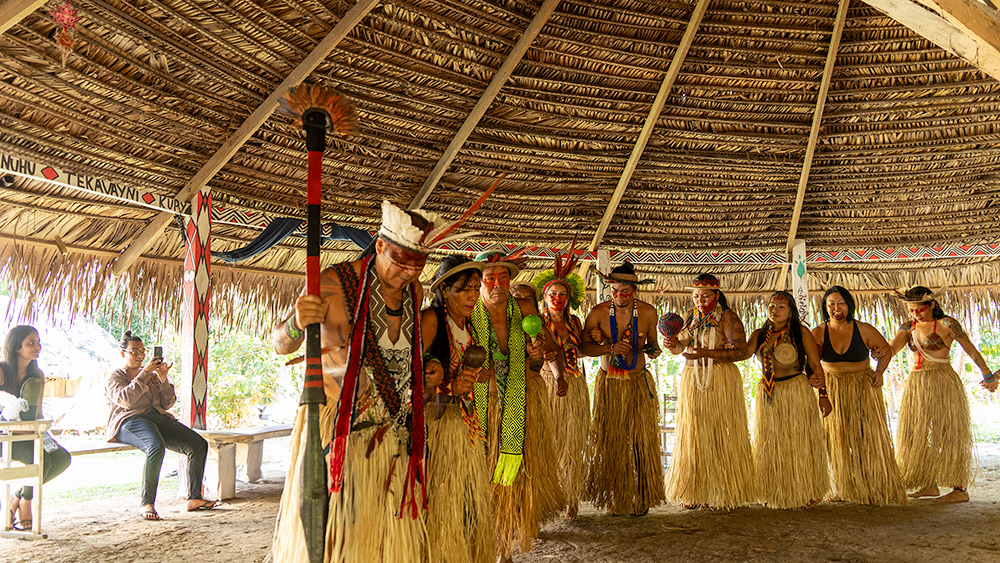
Arrival at the Shanenawa village is in the late afternoon, and you will be welcomed with an emotional ritual. The women of the community, dressed in traditional clothes adorned with beads, sing welcoming songs while the men perform circular dances around a large bonfire. This first night ends with the elders sharing ancestral stories under a starry sky so bright it seems palpable.
IMMERSION IN THE CULTURE
The third day begins with awakening to another chapter of transformation. After breakfast, it is time to touch with hands and heart the ancestral craftsmanship of the Shanenawa. Bracelets, baskets, and weavings carry sacred designs, symbols of the connection between the people and the spirits of the forest. Then, a purifying bath in the village pond invites surrender. Its fresh waters cleanse not only the body’s fatigue but also energies that no longer serve.
The lunch, simple and affectionate, warms like an embrace. Next, the indigenous body painting workshop creates a link between you and the living history of the forest through each stroke. When night falls, the village withdraws in respectful silence. Around the fire, deep conversations about medicines and traditions prepare those who feel the call of the sacred ceremony: a spiritual dive that transforms, heals, and rescues soul memories.
The fourth day invites pause. The body renews in serene waters, the thoughts quiet down. After lunch, the wisdom of the hands reveals itself in the straw weaving workshop, where each intertwined thread is a gesture of cultural continuity. And when the sun softens the sky, it is time to receive the herb bath, with fresh leaves touching the skin like blessings from the forest. At night, the words of the elders echo like ancient chants, and the story of the Shanenawa people is felt as a whisper from the forest to the heart.
DID YOU KNOW? The Shanenawa people carry, with courage, a history of resistance in the face of the wounds of colonization and exploitation of their territories. Today, they keep their culture alive with pride through sacred rituals, crafts, and conscious ethnourism, with practices that strengthen their autonomy and inspire all who cross their paths.
SACRED MEDICINE CEREMONY
The fifth day dawns with welcoming aromas and a breakfast that awakens the senses and soul. Then, the forest invites you to a deep dive into its mysteries, guided by a village guide who, with ancestral wisdom, reveals the secrets of life that pulses among leaves, roots, and bird songs. Lunch in the village is an act of communion with the earth.
In the afternoon, a medicinal clay bath transforms body and spirit, a purification that touches deeply. When the sun begins to say goodbye, the sky paints itself orange and golden, creating the perfect setting for a special dinner with fish prepared in the sacred leaves of the forest. And for those who feel the call, the night holds the silent power of the Sacred Medicine Ceremony, a rite of healing, introspection, and connection with the invisible.
Participation in the Sacred Medicine Ceremony is optional. During the expedition, two ceremonies will be held, each lasting 4 to 6 hours. The medicines used in the ceremonies are: ayahuasca, a drink used to expand consciousness and promote spiritual healing; rapé, a powder made from tobacco and herbs that assists in energetic cleansing and opening spiritual channels; and sananga, a natural eye drop used to cleanse physical and spiritual vision.
THE HEART OF THE FOREST
After a breakfast shared with affection and simplicity, the sixth day opens like a gift. The craft exhibitions delight the eyes and touch the heart, revealing the hands that shape the memory and beauty of a people. Indigenous games, in turn, return light laughter, playful spirit, and the joy of being present, body and soul, in that time that seems to slow down.
As the sun sets behind the trees, dyeing the sky with golden and pink tones, you dive into the sunset, feeling part of the forest, the village, and the living history of the Shanenawa. The following dinner is a celebration of the journey lived so far, with flavors that warm the soul. And when night finally falls, the magic ignites around the bonfire. Music, songs, smiles, and words of gratitude create a unique atmosphere.
The expedition is coming to an end. The seventh and last day holds one of the most symbolic moments of the journey: planting trees in the Amazon. Each seedling placed in the soil carries the promise of life, a gesture of gratitude to the forest that welcomed you, and a silent bond with the generations to come. It is a simple act but full of meaning! In the afternoon, it is time to say goodbye to the village and begin the return journey to Rio Branco. The next day is free to explore the city or catch your flight to discover another Brazilian destination.
ESSENTIAL DETAILS FOR YOUR JOURNEY
The Amazon region has a warm and humid climate all year round, with frequent rains ranging from quick and intense to more constant. Between May and September, rains tend to be less heavy, but humidity remains. Accommodation in the village will be in cabins, and it is essential to bring your own tent, sleeping bag, or hammock. Yellow fever vaccination is recommended at least ten days in advance.
To enjoy the journey with comfort and safety, it is important to bring light, quick-drying clothes that protect from the sun and insects, such as long-sleeved shirts and pants. Also bring insect repellent, sunscreen, suitable hiking shoes, biodegradable hygiene products, your personal medications, and a flashlight with extra batteries. A camera or cellphone can record special moments, always respecting the community’s guidelines regarding photos.
The Shanenawa Amazon Expedition is a celebration of life in its purest form. A rare opportunity to learn from the guardians of the forest, hear the song of the woods, and feel the rhythm of nature. It takes courage to disconnect from the outside world and reconnect with what is most essential inside us!
HOW TO GET THERE
Rio Branco International Airport – Plácido de Castro
VIVALÁ
Vivalá believes that sustainable tourism is a key factor for socio-environmental development and empowerment of Brazilian communities. Therefore, the company creates expeditions that are transformative for travelers, communities, and the planet. Want to learn more about this and other experiences? Visit www.vivala.com.br/.